
Every repair, every report of a signal malfunction, every log of a flashing red light — leaves a trace.
A technician writes the incident, another one fixes it, someone reviews the history, and operations move on.
But few people stop to think that, behind each action, something more valuable is being built: a memory of the system.
That memory — often scattered across service sheets, emails, or disconnected systems — tells a complete story about how a city’s infrastructure behaves.
If we manage to connect it, the city itself can begin to learn.
From Maintenance to Operational Intelligence
For decades, traffic signal maintenance has been a reactive task:
fix what breaks, replace what fails.
But when an organization begins to consolidate its data — dates, locations, causes, duration of interventions — a new possibility emerges: learning from accumulated experience.
That’s exactly what integrated management platforms like Odoo make possible.
By centralizing field reports, technical data, work orders, and costs, each intervention stops being an isolated event and becomes part of a system that can be analyzed, measured, and eventually, predicted.
The Silent Learning of Infrastructure
Over time, the data begins to reveal patterns:
signals that fail more often after heavy rain, components that wear out faster in certain areas, or response times that vary by hour or day.
All that previously invisible knowledge turns into practical guidance for better decisions:
scheduling maintenance before a breakdown, planning replacements more accurately, or budgeting based on evidence — not assumptions.
In this way, infrastructure learns.
And a city that learns becomes safer, more efficient, and more human.
The Role of Data (and People)
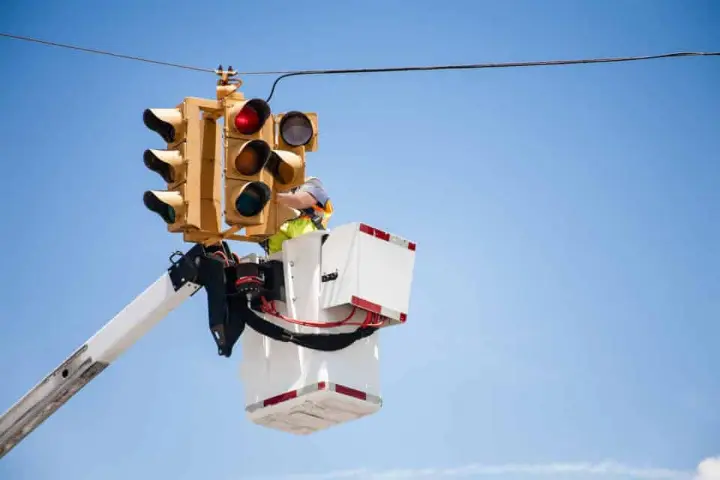
No algorithm can replace the experience of the technicians who work on the streets every day, nor the intuition of those who know each intersection by heart.
But data can amplify that experience.
When data is structured and analyzed with purpose, individual experience becomes collective knowledge.
Each record stops being an administrative task and becomes a contribution to shared learning.
That’s the essence of intelligent infrastructure: not one that has more sensors, but one that learns from its own work.
Learning from the Field
At dagaa, we help organizations like EE turn their operational data into insight.
Companies such as EE have spent years collecting service and maintenance data from traffic signal projects, building an invaluable historical foundation.
Thanks to the availability of public project cost reports in the United States, we can go even deeper — developing predictive models that anticipate failures, optimize resources, and improve system reliability.
Our goal is to help companies and municipalities make the most of what they already have: data that tells the story of how their infrastructure behaves.
Because every city has something to teach — if we learn how to listen to its signals.
If you’re interested in exploring how your organization can use data to improve operations, let’s connect at dagaa.co.
And if you want to collaborate on traffic signal projects or predictive maintenance initiatives, you can reach us at Electrical Excellence.
Because the future of infrastructure will belong to the cities — and the companies — that learn fastest.